So what would context-first agentic AI mean when a flood warning reaches a field office at 02:00? Three things: the duty manager would ask for the agreed response in ordinary language, an affected family would receive a message they can understand and correct, and the donor would see evidence while the response is still moving.
Today, that warning can start a scramble through systems. The duty manager turns to spreadsheets, perhaps a vibe-coded portal, phone calls, contractual commitments, donor rules and local policies. Stock, routes and local partner knowledge sit somewhere else. The beneficiary receives a generic message, or repeats their circumstances to another service. The donor later receives evidence reconstructed from the work.
In a context-first operation, the same trigger starts a bounded mission. The context plane knows who may act, which protocol applies, what the grant permits, which stock exists, what happened during the last flood and which language or channel each community can safely use. Contracted skills inspect those governed records and prepare the response. A person approves the consequential action. The beneficiary receives a usable message and a route to correction or human help. The donor surface shows the evidence as it is written.
That is what “Context Is Everything” means in aid: the system learns the situation before people are asked to learn another system.
My paper argues that a business application has three load-bearing parts: a data store, a policy engine and an interface. That operating model keeps the first two and retires the third. Governed records remain. Policy becomes explicit and readable. Skills and agents perform the work. People meet the organisation through a surface assembled for their role and situation.
Aid has its own version of the interface tax. Staff learn field names, project codes, portals and workflow states before they can do their jobs. Beneficiaries repeat their circumstances to different organisations because each service carries its own schema. Project teams reconcile systems by hand. Donor reporting becomes another round of translation rather than evidence of action.
The destination is to retain the records and the rules while removing the translation layer between human intent and machine state.
A flood response without another portal
Consider a river basin with an agreed anticipatory-action protocol. Its protocol defines the forecast trigger, coverage, funding, protection checks and human approvals.
At 02:00, a monitoring skill detects that the trigger has been met. It verifies the licensed forecast source and identifies the applicable version of the protocol. A skill named “prepare-anticipatory-response” then starts work under a contract that states which data it may touch, which policies it must consult, what evidence it must write, what it costs, who owns it and where humans must decide.
Here, the context plane assembles the situation around the mission. It knows the duty manager's authority, the local partner's responsibilities, the active grant, current stock, previous flood decisions, donor conditions, community contact preferences and the communications channels still available after the power cuts.
The duty manager asks for the agreed response in ordinary language. Skills check stock, routes, supplier commitments, budget, safeguarding rules and communication requirements. A decision pack then shows the trigger evidence, proposed action, cost, conflicting data, policy clauses and approvals required. It also records which skills produced each part.
No payment leaves at this stage. No eligibility list changes. No supplier receives a binding order. Named people make those decisions.
After approval, contracted skills write the authorised instructions back to the finance, logistics and case-management stores. A beneficiary receives the approved message by voice, text, radio or a local worker, according to context rather than a new app requirement. A donor assurance surface shows the same mission through commitments, approvals, exceptions and evidence. Each audience receives a different human surface, while the underlying stores preserve one operational record.
Context does the work that a prompt cannot
“Context Is Everything” defines seven components. Applied to aid, they turn a short instruction into an accountable mission.
- Identity and role. Who is acting: a duty manager, local partner, beneficiary, donor or agent, with the relevant responsibilities, delegations and approval limits.
- Current work. The active grant, case, distribution, referral, response protocol, commitments and deadlines that give the instruction its meaning.
- Entitlements. What each person or skill may see and do, including consent, purpose restrictions, data classifications and the boundary between reading a record and changing it.
- Obligations. Donor conditions, procurement thresholds, safeguarding duties, retention rules, humanitarian principles, jurisdictional constraints and the organisation's own operating policy.
- History. Previous decisions, distributions, exceptions, complaints, supplier performance, case events and approvals, including the evidence that makes consistent action possible.
- Preference. Language, level of detail, accessibility, timing, channel and whether the person wants a recommendation, a decision pack or a conversation with a human.
- Environment. Device, connectivity, location, weather, security, time zone and which contact channel is safe and available now.
With these components, “prepare the agreed response” can carry an entire operating picture. Without them, an agent is a fluent stranger guessing at local reality.
Context must be assembled, versioned and corrected. It cannot be purchased as a feature of the model. Beneficiaries and staff need to see what the system believes about their situation, correct errors and know how those corrections change subsequent action. A context layer that cannot be inspected becomes a surveillance asset with a helpful interface.
Four layers turn the idea into infrastructure
The paper's operating model gives the aid mission four layers.
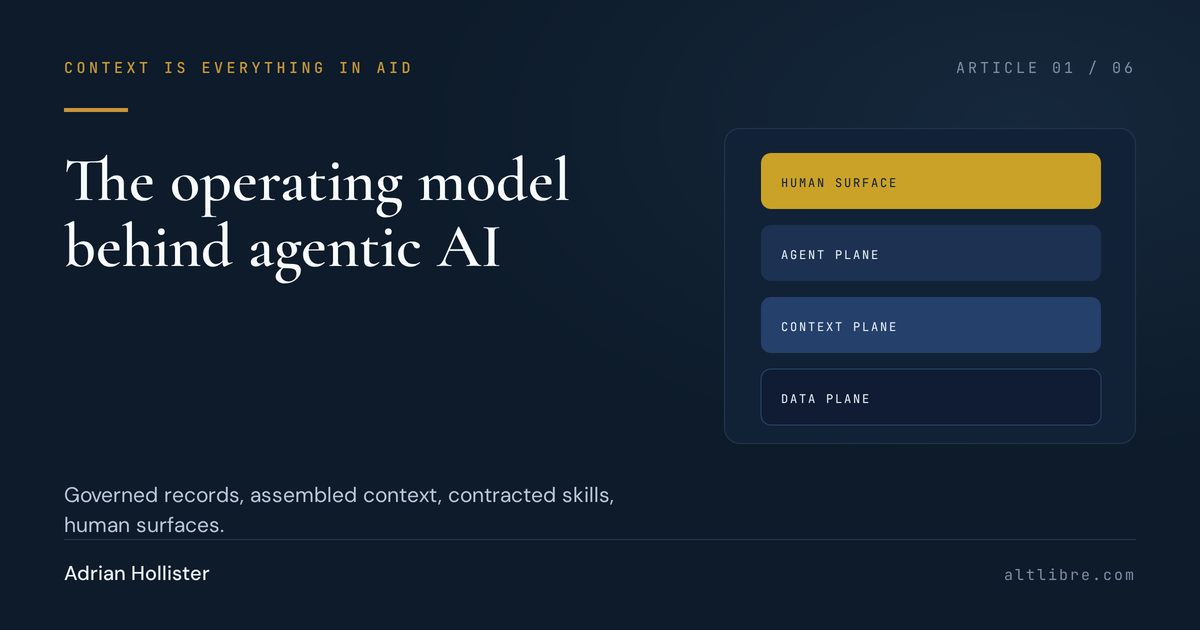
The data plane holds governed stores. Finance, grants, stock, procurement, case management and results remain systems of record with published schemas, classification, retention and data-quality duties. Agents do not replace these records with a conversational archive.
The context plane holds the working situation. It assembles the seven components under an owner, a lawful basis, access controls, provenance and retention rules. It also records where context is processed, which legal jurisdiction applies and who can compel access.
The agent plane holds the skill catalogue. Every skill has an owner, version, contract, tests, cost and lifecycle. Nothing operates unregistered. Skills that prepare a distribution, reconcile a delivery or route a referral can be reviewed and retired with the same discipline once applied to application portfolios.
The human surface serves each participant. A duty manager receives a decision surface. A local partner receives a mobile work surface. A beneficiary receives a service surface in the right language and channel. A donor receives an assurance surface. These surfaces render context; they do not become competing systems of record.
This is the point at which agentic AI becomes an operating model rather than a demonstration. Model choice remains replaceable. Durable value sits in the stores, the policies, the assembled context and the tested skills.
Value must survive three tests
Beneficiaries gain continuity and agency. A person should not have to learn each organisation's terminology or repeat a painful history to every new service. They should be able to correct their context, see consequential actions, contest them and reach a person. Any differentiation that affects assistance must be declared and challengeable.
Project staff regain time and professional judgement. Interface training, duplicate entry, status chasing and evidence reconstruction consume time that could go to communities, partners and difficult operational choices. Staff also need symmetry of use: a system that helps them understand their work cannot become a hidden instrument of algorithmic management.
Donors fund durable capability and receive current evidence. Spending shifts away from portals, training and support towards data quality, context engineering, skill testing and governance. Every skill writes its evidence as it acts, so assurance comes from inspection rather than archaeological reporting. Donors see commitments, exceptions and outcomes without acquiring unrestricted visibility into beneficiary lives.
Who holds the context can steer the response
Aid context can contain identity, location, vulnerability, intent and organisational history. Its concentration creates value and risk in the same asset. Control over that asset can determine whose priorities the agents pursue and whose rules they treat as binding.
Local organisations and representatives of affected communities therefore need a governing role in the context plane. Procurement must name the legal jurisdiction, the keys, the model dependencies, the exit route and the consequences of service withdrawal. Data residency alone does not answer who controls the operating memory.
A donor surface must not become a route around beneficiary entitlements. A staff assistant must not become a covert supervisor. Shared infrastructure must preserve different human surfaces over shared records, with rights and obligations enforced in the context layer rather than left to the wording of a prompt.
Migrate the ceremony first
Begin with one bounded mission and an inventory of its context sources. Identify where identity, work, entitlements, obligations, history, preferences and environment live, who owns each source and how reliable it is. Write the decision classification scheme before writing the first skill contract.
Run the skills in shadow mode against historical or synthetic missions. Let staff, donors and community representatives inspect the decision packs, evidence records and proposed human surfaces. Measure unsupported claims, unsafe tool calls, context corrections, escalation quality, staff time, operating cost and the completeness of the evidence record.
Introduce reversible actions gradually. Retire a form, a duplicate report or a training course only after the replacement has produced evidence under operational conditions. Keep the underlying stores and the manual route intact. Its migration sequence is deliberate: migrate the ceremony first and the record last.
The prize is an aid operation in which people state intent, machines hold the ontology and every action leaves enough context to be explained and challenged.
Which aid process still forces people to learn the machine's language before they can receive or deliver help?
Next: giving the beneficiary a surface they can inspect and correct, with consent, human handover and no requirement to repeat their story.