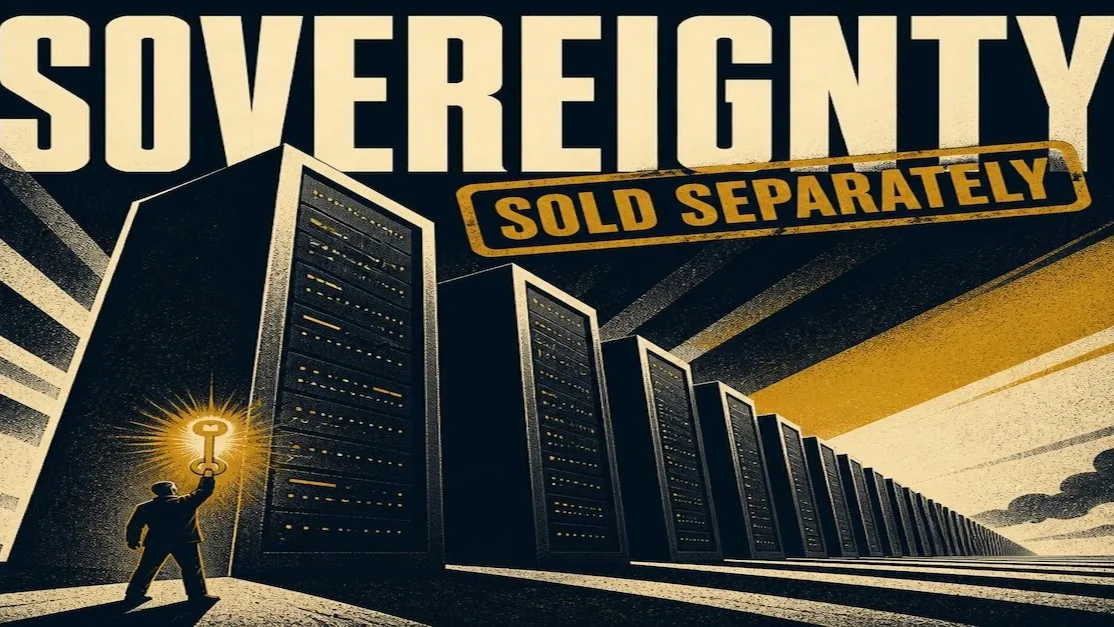
A European AI layer does not mean a European ChatGPT, and it does not mean prestige projects with ribbons. It means something plainer: that a European organisation with a sensitive workload has real options, a model it can run, compute it can contract for under European law, terms it can exit, at prices that do not punish the choice. Credible means buyable. Everything else is just theatre.
I have promised this piece twice: once in a reply to Armin Prior, whose line about Airbus moving infrastructure rather than architecture started this series, and once at the end of the last article. Time to pay up.
That opening sentence is my argument, and it deserves a name, because named tests get used and adjectives do not. Call it the buyability test: can the organisation buy the capability it needs, under law it answers to, on terms it can exit, at a price that does not punish the choice? A European AI layer that passes the buyability test is credible. One that fails it is a brochure.
Run the test over the market as it stands, and four requirements fall out, all of them obvious once you look.
1. Compute You Can Contract For
This one has moved, and it deserves more attention than it is getting. This summer the Commission opened the tender for up to seven AI gigafactories: roughly ten billion euros of EU and member-state money set against an expected twenty billion or more of private investment, bids closing 12 November, decisions early next year, machines running by 2028 if the timetable holds. Seventy-six consortia across sixteen member states expressed interest before the call even opened, so the appetite is real.
So are the caveats. The public share has been trimmed from the original ambition, grid connections and planning consents are Europe's usual slow ground, and most of the hardware inside will still be American silicon. I made my peace with that last point in the first piece of this series; the near-term prize is not European chips, it is capacity operated under European law that a buyer can put in a contract.
One further caveat has gone almost unnoticed. A gigafactory is a training story: the money, the power connections and the consortia are all pointed at building very large models. A hospital trust or a bank with a sensitive workload does not need to train one. It needs to run one, cheaply and reliably, under European law. Training capacity and serving capacity are different products with different economics. So the question to ask of any gigafactory is not how many GPUs it houses but whether inference capacity will be reserved, priced and contractable under EU law, and what happens to the terms when the founding consortia want the machines for their own models.
What moved this summer is not capacity but the prospect of contractability, and that counts only if the serving half of the market is written into the tender rather than assumed. Sovereignty is built at the contract, not the ribbon-cutting.
2. A Lab Whose Direction Stays European
Europe's frontier alternatives are few, and the most important of them spent the summer becoming more entangled with Microsoft: capital, distribution, a joint go-to-market plan. I wrote at the time that the gains were real and the terms were not Europe's to set, and nothing since has changed my reading. Dependency never announces itself. It arrives as convenience: distribution through a marketplace you already use, compute credits that make the first year cheap, a partner whose roadmap becomes yours by degrees.
Europe has solved this problem once, at considerable cost. Airbus exists because governments decided aerospace was strategic and then paid for that decision for decades. No equivalent decision has been taken about a frontier lab. Until one is, the only guarantee that cannot be revised in a boardroom is open weights. A lab can be bought; weights already downloaded cannot be repossessed, repriced or switched off. Weights on a thousand European machines are a fact, and every other assurance is a promise. That is why the open-weight commitment remains the most sovereignty-relevant clause in the Microsoft-Mistral partnership, and why any European strategy that does not treat frontier-lab independence the way aerospace was treated is decoration.
3. The Unglamorous Middle
Between the model and the user sits the layer where sovereignty is decided, and it comes down to five decisions:
- where the inference runs;
- what identity system stands in front of it;
- what is logged and where the logs live;
- which model version is pinned and who decides when it changes;
- what the exit clause says.
Leaderboards measure none of these; auditors will measure all of them. The version question is the one most contracts miss: a hosted model can be retired or repriced on the vendor's schedule, and an exit clause that ignores versioning covers a product that may not exist when you need it.
This is also where the good news lives, because the middle layer needs no gigafactory and no ten-billion-euro tender; it needs ordinary engineering and attention. Serving, orchestration, logging, identity: the skills are the ones competent infrastructure teams already have. What is scarce is the decision to treat the work as sovereignty rather than plumbing. I have spent the last month talking with a Spanish company that brought its entire AI estate home, open-weight models on its own GPUs in its own building, serving one of Europe's biggest retailers, and I will tell that story properly next Wednesday, because one existence proof beats any amount of argument.
4. Buyers Who Make It Commercial
The cloud argument was not won by indignation; it was won when price parity arrived and procurement started asking the jurisdiction question in writing. When enough tenders carry the same three columns (who hosts the model, where the inference runs, who provides the identity) suppliers build for the columns. A question asked in fifty tenders becomes a feature roadmap.
The same lever is already being pulled at the regulatory end: the EU's new framework requires the most sensitive public workloads to keep AI inference data inside the Union, which quietly creates the first guaranteed demand a European AI layer has ever had. Guaranteed demand gives a supplier a revenue line it can plan against, which is what turns a policy position into a market. Any organisation, public or private, can add to that demand without waiting: score the three columns alongside price, and ask for open-weight options in every tender. Most tenders will get none back at first. Ask anyway. Suppliers read tenders the way the rest of us read the news.
The Objections, Answered Short
The objections come in three, and the short answers are these. Most sensitive workloads do not need the frontier; they need a version that does not change underneath them. The middle layer is ordinary engineering. And the premium is real, so decide it in advance, as you would for any resilience measure, and treat it as the price of keeping an exit open.
Britain, as usual in this series, sits in the same weather with fewer umbrellas: no gigafactory tender, no frontier lab, the same dependency arithmetic. The discipline travels anyway. Know where your AI workloads' data flows; prefer open weights for anything you would mind losing; price your exit before you need it. None of that requires Brussels, only a decision.
What to Do While the Tender Window Is Open
- Inventory where every AI workload's data flows, including the ones that arrived as features inside products you already own.
- Put the three columns into your procurement scoring for anything that touches sensitive data.
- Take your most exposed workload and price its exit while you do not need it.
None of it needs a strategy paper or permission. It needs the test, applied once, in writing.
The Test, Five Years Out
Apply the buyability test five years out. In 2031, does a European organisation with a sensitive AI workload pass it? The tender could put compute under European law, provided the serving half is written in rather than assumed. Open weights could keep the models beyond anyone's reach. The middle layer can be built by any competent team this year. And the buyers, collectively, decide whether any of it becomes a market or stays a press release. Four requirements, three of them in motion, one of them entirely in our hands.
Next: the company that took its AI home.
Until then, a question worth carrying into your next procurement cycle: if the gigafactories arrive on schedule, what would persuade your organisation to place a sensitive workload on one, the price, the law, or proof someone else went first?