
Last week, in the comments under my Airbus piece, a couple of readers made observations that deserved a better answer than a reply box allows. The sharpest: Airbus moved infrastructure, not architecture. ERP and PLM systems are portable in a way that AI pipelines and their data dependencies are not. I said at the time that the sovereignty debate's next front would be whether Europe can offer a credible home for the AI layer before that dependency hardens.
Then Microsoft announced a multibillion-dollar expansion of its partnership with Mistral, Europe's flagship AI company, and draped the whole thing in the word "sovereign". I fear the next front has arrived on schedule.
The Easy Argument Is Over
The infrastructure argument is over. Airbus proved a serious European enterprise can move its most critical systems under European law at competitive cost, and the EU has given public buyers the framework to demand the same. That argument took a decade. It was the easy one.
Look at what Airbus did not move. Skywise, its aviation-data and AI platform, stayed on AWS. The boldest sovereignty mover in Europe examined its AI layer and left it exactly where it was. Data gravity is the reason, and it is the tell.
Dependencies are not signed into existence. They harden through defaults. No single step commits anyone to anything. The cement still sets.
Every workflow wired into one AI stack, every dataset that pools where the inference runs, every team trained on one ecosystem's tools is a footprint in wet cement. The cloud dependency set this way over fifteen quiet years, and Europe is now spending serious money prising it open. The AI layer is setting faster, years rather than decades, because the gravity is stronger and the adoption is quicker. Mistral's own chief executive conceded the point while announcing the deal: Europe has a compute gap. That gap is why Europe's champion needed an American partner with a chequebook.
Two Dependencies That Matter
Compute. Frontier AI runs on scarce silicon and enormous capital. Europe is short of both. Even the "European capacity" in this deal means thousands of Nvidia GPUs; the layer beneath the models stays American whichever flag flies over the data centre. Nobody fixes that this decade.
Models. Europe's alternatives here are few and thin, and the most important of them just became more entangled with Microsoft: Redmond's capital, Azure's distribution, a joint go-to-market plan. The gains are real. More European GPU capacity, models reaching enterprises that would never have found them, revenue funding the only serious European frontier programme, continued open-weight releases. But a champion whose compute, capital and distribution all route through one American company is a champion on terms. The terms are not Europe's to set.
Sovereign as a Product Tier
And a third thing is happening, to the word rather than the technology. "Sovereign" is becoming a product tier. Microsoft's sovereign cloud, in its connected forms, is still operated by a US company within reach of US law. Residency is geography. Sovereignty is jurisdiction. The label does not change the operator.
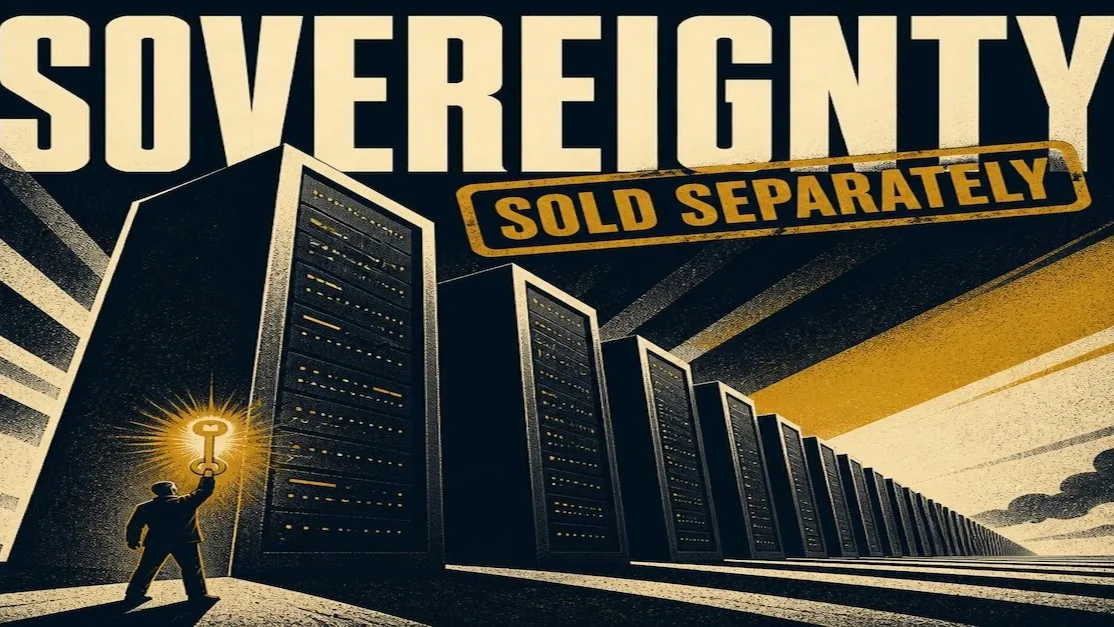
This is where the title of this piece earns its keep. When the company that could not guarantee French data's protection to the French Senate becomes the loudest vendor of "sovereignty", buying the label feels like progress. It is the opposite. Every organisation that purchases the word has spent its sovereignty budget, and its urgency, on the shelf version, and the window for building the real thing closes a little further.
Three Things to Hold Onto While the Cement Is Wet
Open weights. A model you can download, self-host and fine-tune cannot be switched off, repriced or subpoenaed at source. Mistral's continued open-weight commitment is the most sovereignty-relevant clause in the whole announcement.
The disconnected tier. Buried in the deployment options is a fully disconnected environment, one that runs without calling home. That is the single configuration that changes jurisdictional exposure in fact rather than in name. Regulated buyers should ask for it by name.
The identity layer. Whoever satisfies your identity provider can often reach your data wherever it lives. Score your IdP's jurisdiction alongside everything else, or you have moved the crown jewels and left the keys with the old landlord.
All three work identically in Britain, where the weather is the same and the umbrellas are fewer.
Someone Is Choosing the Default Right Now
Somewhere in your organisation this quarter, someone is choosing the default AI stack for a workflow. Which copilot. Which model endpoint. Which platform the new process gets wired into. Nobody in the room is calling it a sovereignty decision. In five years it will turn out to have been one, because the accumulated defaults are the decision, and by then choosing differently will be a business case nobody wants to write.
The infrastructure argument ended well because someone finally moved. The AI layer is setting faster, and it will not wait a decade for its Airbus. Until then, a nearer question: in your organisation, who is watching the defaults?